

In order to index a large number of articles or a large amount of text efficiently according to specific criteria, automatically inserted coloured markings and the display of supplementary information can be helpful.
Project duration: ongoing
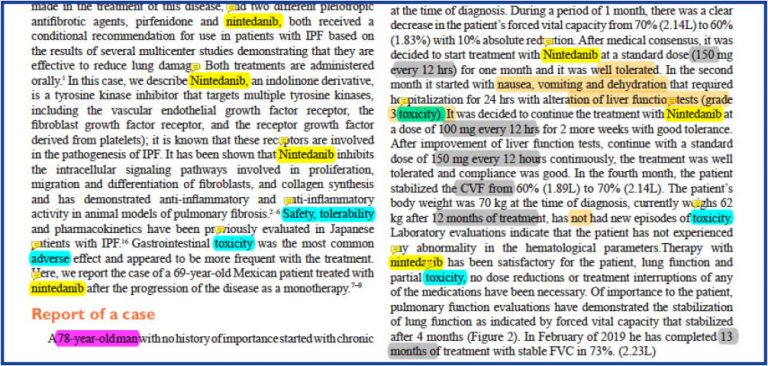
We typically receive between 50 and 80 pharmacological documents (articles in journals, conference reports, etc.) per day, which we index rapidly according to specific criteria such as drug name, indication, adverse effects, etc., ensuring that the content is as complete and high-quality as possible. Our ARTIS software is supporting this process intelligently and proactively. One example are the various colour markings that are created during the initial automatic processing.
Each colour represents a specific category – for example yellow for drug names, cyan for safety-related information, or red for synonyms and abbreviations. When you hover over them with the mouse, the underlying information becomes visible. This can be the entry from the thesaurus or, in the case of medicines, the indication area. These categories are based on lists of keywords or names that we have maintained and expanded over the years. Document editors can also insert comments, which are identified by grey markings or individual colours.
ARTIS’ functionality offers other valuable benefits, such as fuzzy search. This can be used to find and highlight terms in different spellings, including spelling mistakes or its acronyms. We can narrow or broaden this fuzzy search as required. Accuracy is further enhanced by a precisely defined rejection list, which minimises false positives. In general, these additional features increase the precision of processing and also make the final check much easier.
ARTIS is far superior to any individual review: while PDF documents can normally only be searched individually and sequentially using multiple keywords, ARTIS allows you to search multiple documents simultaneously – even entire journals, using multiple search terms at once. Formats such as Excel, Word or PowerPoint can also be automatically converted to PDF and processed in this way – even files in an image format such as TIFF or JPG, after a powerful OCR (optical character recognition) software has been automatically applied to them. This is where fuzzy search is a huge advantage.
As a result of this processing, completely new types of questions are possible for our clients. For example, the question of the growth rate of a specific tumour or the effect of COVID-19 on diabetes patients – in a very short time, in many articles, in many languages, with the software guiding the user specifically to the relevant sections.
The colour highlighting feature can be applied within arbitrary contexts without a loss of quality.